
Recruitment software has come a long way. Recruiters can now store thousands of resumes, track applications, schedule interviews, send emails, and manage candidate pipelines from one place.
But there is one important question:
Is your recruitment software actually helping you make better hiring decisions, or is it simply storing more candidate data?
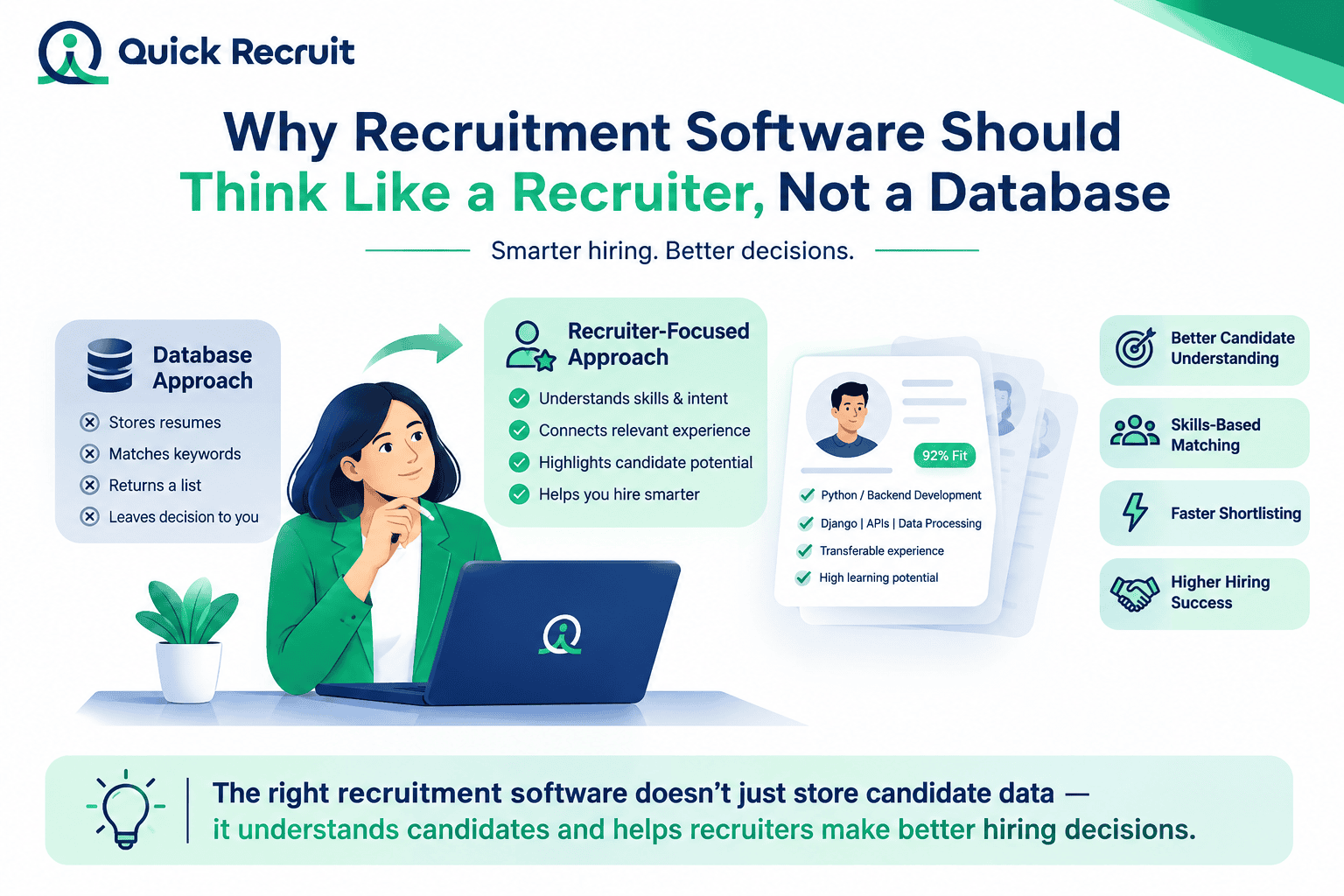
A database can tell you what is in a resume. A recruiter wants to understand what that information actually means.
That difference is becoming increasingly important as hiring becomes more skills-focused, competitive, and technology-driven.
Modern recruitment software should not just organize candidates. It should help recruiters understand candidates, recognize relevant skills, connect information, and make better decisions.
What Does It Mean for Recruitment Software to “Think Like a Recruiter”?
A recruiter rarely looks at a resume as a collection of keywords.
Instead, they ask questions such as:
- Does this candidate actually have the skills required for the role?
- Does their previous experience relate to this position?
- Are their skills transferable?
- Have they worked in a similar environment?
- Could their career path make sense for this job?
- Is there potential that the resume does not immediately show?
- Would this person be a good fit for what the hiring manager needs?
Traditional recruitment databases are mainly designed to store and retrieve information.
Recruiter-focused recruitment software should go one step further.
It should help connect the information and turn candidate data into useful hiring insights.
The Chartered Institute of Personnel and Development (CIPD) explains that effective recruitment is about ensuring an organisation gets people with the relevant skills and abilities it needs, rather than simply filling a vacancy.
That is the mindset modern recruitment technology should support.
A Database Stores Resumes. A Recruiter Understands Them.
Imagine a recruiter is hiring a software developer.
A traditional system might search for:
“Python Developer”
and return candidates whose resumes contain those exact words.
But what happens when a candidate’s resume says:
Software Engineer | Backend Development | Django | APIs | Data Processing
They may have the right technical background, but their resume does not use the exact job title.
A recruiter may still recognize the connection.
This is where smarter recruitment software can make a difference.
Instead of relying only on exact keywords, modern systems should understand:
- Skills
- Related technologies
- Job responsibilities
- Transferable experience
- Seniority
- Industry experience
- Candidate intent
- Role requirements
This approach is closely connected to the growth of skills-based hiring.
LinkedIn research has highlighted how focusing on skills can help employers identify qualified candidates who might otherwise be overlooked because of traditional requirements such as specific degrees or job titles.
Recruitment Is About Context, Not Just Keywords
Keywords are useful.
But keywords without context can create problems.
Consider two candidates:
Candidate A:
Has the exact job title but limited experience with the actual responsibilities.
Candidate B:
Has a different job title but has performed almost all of the responsibilities required for the position.
A keyword-based system may rank Candidate A higher.
An experienced recruiter might prefer Candidate B.
Why?
Because recruiters understand that job titles are not always consistent between companies.
One company may call someone a:
- Talent Acquisition Specialist
- Recruitment Consultant
- Talent Partner
- Hiring Specialist
But the actual responsibilities could be very similar.
Recruitment software should therefore understand the relationship between roles, responsibilities, skills, and experience rather than treating every resume as a collection of isolated words.
Modern Recruitment Software Should Understand the Job Too
Another major difference between a database and intelligent recruitment software is understanding the job requirement.
A recruiter doesn’t simply ask:
“Does this resume contain the keyword?”
They ask:
“What does the hiring manager actually need?”
For example, a job description may say:
“Looking for a sales professional with B2B SaaS experience, strong communication skills, lead generation experience, and knowledge of CRM tools.”
A useful recruitment system should break this requirement into meaningful components.
It should understand:
Must-have skills
- B2B sales
- Lead generation
- CRM
Experience
- SaaS
- Business-to-business selling
Soft skills
- Communication
- Negotiation
- Relationship building
This makes candidate screening more relevant.
CIPD’s guidance on selection methods emphasizes that candidates should be assessed based on their ability to perform the role and that selection processes should be clear, structured, and objective.
Recruitment Software Should Help Recruiters See Potential
One of the biggest weaknesses of traditional screening is that it can focus too heavily on what a candidate has already done.
But recruiters also look for potential.
For example, a candidate may not have experience with a particular tool but may have worked with several similar technologies.
A good recruiter might think:
“They haven’t used this exact platform, but they have experience with three similar systems. They could probably learn it quickly.”
This is an important distinction.
Recruitment software should help recruiters discover transferable skills and relevant experience, rather than automatically rejecting candidates because one keyword is missing.
LinkedIn’s research on skills-based hiring similarly points toward evaluating what candidates can actually do instead of relying too heavily on traditional credentials.
It Should Also Understand Candidate Experience
Recruitment is not only about recruiters.
There is another person on the other side of the process:
the candidate.
A system can be technically efficient but still create a frustrating hiring experience.
For example:
- Candidates receive repetitive messages.
- Interview scheduling takes too long.
- Applications disappear into a system.
- Candidates don’t know what happens next.
- Recruiters struggle to follow up on time.
Good recruitment software should help recruiters manage these experiences as well.
LinkedIn describes candidate experience as the way a job seeker perceives the organisation throughout the hiring process, from the job description through interviews and communication.
CIPD also notes that the length and overall experience of the recruitment process are important considerations when selecting candidates.
So recruitment technology should not only ask:
“How can we process more candidates?”
It should also ask:
“How can we make the hiring process better for candidates and recruiters?”
AI Can Make Recruitment Software More Recruiter-Like
This is where AI recruitment software becomes particularly useful.
AI can help recruitment teams move beyond simple database searches by analyzing large amounts of information and identifying relationships that may be difficult to find manually.
For example, AI can assist with:
- Resume screening
- Candidate matching
- Skills identification
- Candidate ranking
- Job description analysis
- Candidate sourcing
- Interview scheduling
- Candidate communication
- Talent pool rediscovery
CIPD’s research shows that organisations are increasing their use of technology in recruitment and onboarding, with AI and machine learning becoming part of recruitment processes such as sourcing and screening.
However, AI should not replace recruiter judgment.
It should support it.
That distinction matters.
Recruiter + Technology Is Better Than Recruiter vs. Technology
The goal of recruitment automation should not be:
“Let technology make every hiring decision.”
The better goal is:
“Let technology handle repetitive work so recruiters can focus on decisions that require human judgment.”
Recruiters still need to understand:
- Team dynamics
- Candidate motivation
- Communication
- Culture
- Career goals
- Hiring manager expectations
- Business priorities
Technology can process information quickly.
Recruiters provide context.
The strongest recruitment process combines both.
What Should Recruiter-Focused Recruitment Software Do?
A modern recruitment platform should ideally help recruiters move through the hiring process like this:
Job requirement → Skills → Candidate discovery → Candidate understanding → Matching → Human review → Interview → Decision
Instead of:
Resume → Keyword search → Database result
That is the difference between simply managing recruitment data and actually supporting recruitment decisions.
A recruiter-focused system should make it easier to answer:
1. Who matches this role?
Not just who contains the right keywords.
2. Why does this candidate match?
The system should provide understandable reasons behind the match.
3. What skills does the candidate bring?
Skills should be considered alongside experience and responsibilities.
4. What might we be missing?
The system should help recruiters discover relevant candidates who may not look perfect on paper.
5. What should the recruiter do next?
Recruitment software should help move candidates through the process instead of simply storing them.
The Future of Recruitment Software Is More Human
Recruitment technology will continue to become more intelligent.
But smarter technology does not mean removing humans from recruitment.
It means giving recruiters better information at the right time.
The future of recruitment software is not about having the biggest database.
It is about making the database useful.
A system with 500,000 candidate profiles is not necessarily better than a system with 50,000 profiles if recruiters cannot quickly understand which candidates are relevant.
The real value comes from turning candidate data into actionable insight.
CIPD’s recruitment guidance emphasizes the importance of identifying the right person for the role, attracting suitable candidates, and managing the selection process effectively.
That is exactly where recruitment software needs to evolve.
Final Thoughts
Recruitment software should do more than store resumes.
It should understand the job, the skills, the candidate, and the hiring process.
A database answers:
“What information do we have?”
Recruiter-focused recruitment software should help answer:
“What does this information mean for this hire?”
That is the real shift happening in recruitment technology.
The best systems will not try to replace recruiters. They will help recruiters spend less time searching, sorting, and updating records—and more time understanding people and making better hiring decisions.
The future of recruitment software isn’t just about storing more candidates. It’s about understanding them better.