
Table of Contents
Recruitment can look simple from the outside: receive a job requirement, find candidates, conduct interviews, and make a hire.
But behind every successful hire is a large amount of information to manage.
Candidate resumes, interview feedback, job requirements, recruiter notes, emails, phone calls, interview schedules, client updates, follow-ups, and hiring reports all need to move through the recruitment process.
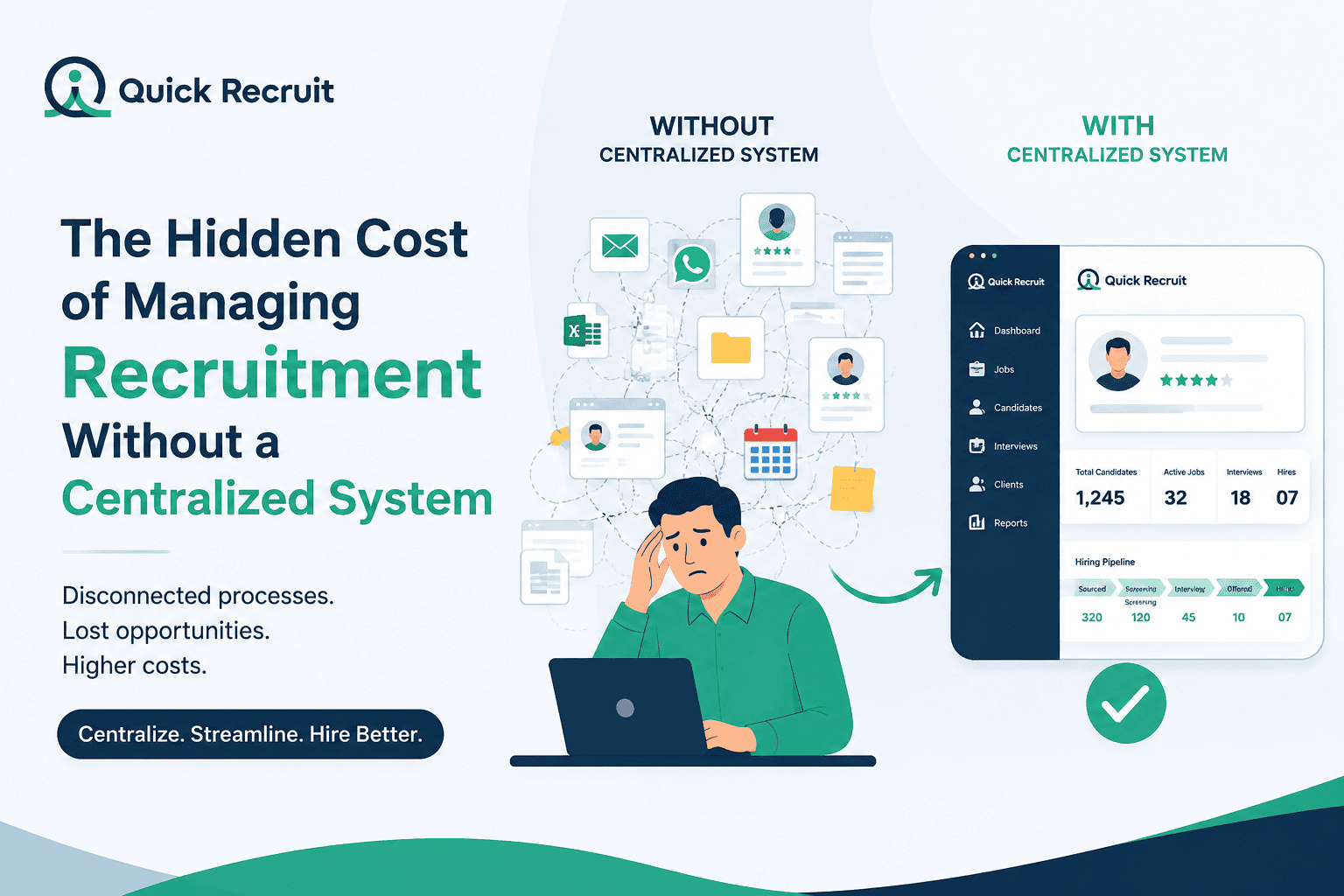
When this information is spread across spreadsheets, emails, messaging apps, folders, and disconnected tools, recruitment becomes harder to manage.
The problem is not always obvious.
You may still be filling positions. Your recruiters may still be working every day. Candidates may still be getting interviewed.
But the business can quietly lose time, money, productivity, visibility, and good candidates.
This is the hidden cost of managing recruitment without a centralized recruitment system.
What Is a Centralized Recruitment System?
A centralized recruitment system brings important recruitment activities into one connected platform.
Instead of keeping candidate information in one spreadsheet, interview schedules in another tool, communication in email, and recruiter notes somewhere else, a centralized system gives recruiters one place to manage the hiring workflow.
Depending on the platform, this can include:
- Job management
- Candidate database
- Resume parsing
- Candidate sourcing
- Resume screening
- Applicant tracking
- Interview scheduling
- Candidate communication
- Recruiter collaboration
- Client management
- Recruitment reporting
- Hiring analytics
- Candidate evaluation
A modern recruiting ATS can connect these activities and give recruiters a clearer view of every candidate and job.
This matters because recruitment is not just about finding candidates. It is about managing information and decisions efficiently throughout the entire hiring journey.
Why Is Recruitment Becoming More Difficult to Manage?
Recruitment teams today often deal with large volumes of applications, multiple job openings, different hiring managers, several sourcing channels, and candidates at different stages of the hiring funnel.
At the same time, recruiters are expected to work faster and provide a better candidate experience.
LinkedIn’s 2025 Future of Recruiting research found that 37% of talent acquisition professionals were already experimenting with or actively integrating generative AI into their hiring processes. Those using generative AI reported saving an average of 20% of their workweek.
This shows an important shift: recruitment teams are increasingly looking for technology that reduces repetitive work and gives recruiters more time for strategic activities such as candidate engagement and relationship building.
But technology only creates value when the recruitment process itself is connected.
7 Hidden Costs of Recruitment Without a Centralized System
1. Recruiters Spend Too Much Time on Administrative Work
One of the biggest hidden costs is recruiter productivity.
Imagine a recruiter working on five open positions.
Candidate information may be stored in Excel.
Resumes may be downloaded into folders.
Interview feedback may arrive through email.
Candidate conversations may happen through WhatsApp or phone calls.
Job requirements may be stored in documents.
Recruiter notes may be written separately.
The recruiter then has to repeatedly move information from one place to another.
These small tasks may take only a few minutes each.
But when they happen dozens or hundreds of times every week, the lost time becomes significant.
Instead of spending more time sourcing, evaluating, and building candidate relationships, recruiters spend their working hours searching for information and updating records.
A centralized recruitment system can reduce this administrative burden by bringing candidate and job information into a single workflow.
2. Candidate Information Gets Lost or Duplicated
Recruitment generates a huge amount of candidate data.
Without a centralized system, the same candidate may appear in multiple spreadsheets, email threads, folders, or databases.
One recruiter may have the candidate’s latest resume.
Another recruiter may have their previous interview feedback.
Someone else may have the candidate’s contact information.
This creates two problems:
Duplicate data and missing information.
Recruiters may accidentally contact candidates who have already been contacted.
They may miss previous interview feedback.
They may also fail to recognize that an existing candidate already matches a new job requirement.
A centralized candidate database gives recruitment teams a single source of truth.
Instead of asking:
“Who spoke to this candidate?”
or
“Where is the latest resume?”
the recruiter can check the candidate’s complete history in one place.
3. Slow Hiring Can Increase Recruitment Costs
Time is one of the most important resources in recruitment.
Every additional day a position remains open can create operational pressure for the business.
According to SHRM’s 2026 recruiting benchmarking data, the median time-to-fill for nonexecutive positions was 39 calendar days, while more than two-thirds of organizations reported difficulties hiring for open positions.
SHRM’s 2025 benchmarking also found that the median time-to-fill for executive and nonexecutive roles was roughly a month and a half.
A fragmented recruitment process can make delays worse.
For example:
- A recruiter receives a job requirement.
- The requirement is manually entered into different tools.
- Candidate sourcing begins.
- Resumes are manually reviewed.
- Interview scheduling happens through email.
- Feedback is collected separately.
- Recruiters follow up manually.
- Hiring managers wait for updates.
Every additional handoff creates another opportunity for delay.
A centralized recruitment system can help reduce unnecessary steps and make bottlenecks easier to identify.
4. Good Candidates Can Drop Out
Candidates do not experience recruitment as a collection of internal tools.
They experience it as one journey.
If a recruiter takes too long to respond, forgets a follow-up, repeatedly asks for the same information, or delays interview scheduling, candidates may lose interest.
This becomes particularly important when hiring competitive talent.
A candidate who is waiting for interview feedback may simultaneously be interviewing with another company.
A candidate who receives no response for several days may assume the opportunity is no longer active.
A centralized recruitment system can help recruiters track candidate stages, follow-ups, interviews, and communication.
This does not automatically create a great candidate experience.
But it gives recruiters the visibility needed to provide a more consistent experience.
5. Hiring Managers Get Poor Visibility
Recruitment is rarely handled by recruiters alone.
Hiring managers, HR teams, department heads, and business leaders often need visibility into the hiring pipeline.
Without a centralized system, recruiters may spend considerable time creating manual updates.
For example:
Hiring manager:
“How many candidates are currently in the pipeline?”
Recruiter:
“Let me check the spreadsheet.”
Then:
“How many were shortlisted?”
“Who has completed the interview?”
“Which candidates are waiting for feedback?”
“Which sourcing channel produced the best candidates?”
“How long has this position been open?”
If the answers require searching through multiple tools, recruitment reporting becomes slow and unreliable.
A centralized recruitment system can provide dashboards and reports that show information such as:
- Open positions
- Candidates by stage
- Interview status
- Source of candidates
- Recruiter performance
- Time-to-hire
- Time-to-fill
- Candidate pipeline
- Hiring progress
SHRM also highlights time-to-hire, source of hire, and quality of hire as important metrics for connecting recruiting activity to business outcomes.
6. Recruitment Agencies Face an Even Bigger Challenge
For recruitment agencies, fragmented recruitment management can become even more expensive.
An agency may simultaneously manage:
- Multiple clients
- Multiple job requirements
- Hundreds of candidates
- Different recruiters
- Candidate submissions
- Interview schedules
- Client communication
- Placement status
- Follow-ups
- Recruitment revenue
Managing all of this through spreadsheets and disconnected applications can quickly become difficult.
This is where recruitment software for agencies becomes particularly valuable.
A centralized platform can connect candidate management with job and client management, helping agencies maintain better visibility across their recruitment operations.
For example, recruiters can track which candidates were submitted to which clients, what stage they are currently in, and what action needs to happen next.
This reduces the risk of information falling between the cracks.
7. Manual Recruitment Makes Scaling Difficult
A recruitment process that works for 10 candidates may not work for 1,000 candidates.
As hiring volume increases, manual processes become harder to maintain.
Consider a growing recruitment team.
More jobs mean:
More candidates → more resumes → more communication → more interviews → more data → more follow-ups.
If the process remains manual, workload increases with every new requirement.
Recruitment teams may respond by hiring more recruiters simply to manage administrative work.
But the better solution is often to improve the process itself.
Automation can handle repetitive tasks while recruiters focus on activities requiring human judgment.
This is one reason AI recruitment software is becoming increasingly relevant.
LinkedIn’s research found that recruiters using generative AI reported saving about 20% of their workweek on average, with saved time being redirected toward activities such as candidate screening and skills assessment.
Centralized Recruitment vs. Fragmented Recruitment
The difference becomes clearer when we compare the two approaches.
| Fragmented Recruitment | Centralized Recruitment |
|---|---|
| Candidate data across multiple files | Central candidate database |
| Manual resume screening | Automated/AI-assisted screening |
| Email-based follow-ups | Centralized candidate communication |
| Separate interview calendars | Integrated scheduling |
| Manual reports | Automated recruitment analytics |
| Difficult team collaboration | Shared candidate information |
| Duplicate candidate records | Reduced duplication |
| Limited pipeline visibility | Real-time recruitment pipeline |
| Manual client updates | Centralized client/job tracking |
| Difficult to scale | Easier to scale |
The goal is not simply to replace spreadsheets.
The goal is to create a recruitment process where information moves smoothly from one stage to another.
How AI Can Reduce the Hidden Cost of Recruitment
Artificial intelligence is changing how recruitment teams handle repetitive tasks.
Modern AI recruitment software can assist with activities such as:
- Resume parsing
- Candidate matching
- Resume screening
- Candidate ranking
- Skills identification
- Job description creation
- Candidate sourcing
- Recruitment analytics
- Communication assistance
Instead of manually reviewing every resume, recruiters can use AI to identify candidates who appear most relevant to a particular job.
However, AI should support recruiters rather than completely replace human judgment.
This is important because hiring decisions can affect people’s careers.
The UK Information Commissioner’s Office has highlighted the need for transparency, fairness, safeguards, and meaningful human involvement when automation is used in recruitment.
Therefore, organizations evaluating AI recruitment tools should consider not only speed but also:
- Data privacy
- Transparency
- Bias monitoring
- Human oversight
- Candidate communication
- Responsible use of automation
The best recruitment technology should make recruiters more effective—not remove the human element from hiring.
What Should a Centralized Recruitment System Include?
Not every organization needs the same features.
However, a good centralized recruitment platform should ideally support the major stages of the hiring process.
1. Candidate Management
Store resumes, candidate profiles, notes, communication history, and recruitment activity in one place.
2. Job Management
Create and manage job requirements while tracking candidates against each position.
3. Applicant Tracking
A recruiting ATS can help recruiters monitor candidates as they move through different hiring stages.
4. Resume Parsing and Screening
Automatically extract important information from resumes and help recruiters identify relevant candidates.
5. Candidate Matching
Use skills, experience, qualifications, and job requirements to identify suitable candidates.
6. Interview Scheduling
Reduce back-and-forth communication by making interview scheduling easier.
7. Recruitment CRM
Maintain relationships with candidates and clients beyond individual job openings.
8. Analytics and Reporting
Track important recruitment metrics and identify bottlenecks in the hiring funnel.
9. Team Collaboration
Allow recruiters and hiring managers to work from the same candidate information.
10. Automation
Automate repetitive activities while keeping recruiters in control of important decisions.
How to Know If Your Recruitment Process Needs a Centralized System
You may need to rethink your recruitment process if your team frequently says:
- “Where is that candidate’s resume?”
- “Who contacted this candidate?”
- “Did the hiring manager give feedback?”
- “Which candidates are waiting for an interview?”
- “How many candidates did we submit?”
- “Can you update the spreadsheet?”
- “Which source gave us this candidate?”
- “When did we last contact this candidate?”
- “Can you prepare the recruitment report?”
These questions are not necessarily signs of poor recruiters.
They are often signs of a poorly connected recruitment process.
If recruiters spend more time managing recruitment data than actually recruiting, the system may be the problem.
How to Calculate the Hidden Cost
One useful way to evaluate your recruitment process is to calculate the time spent on administrative tasks.
For example:
Number of recruiters × hours spent on manual admin per week × hourly cost × 52 weeks
Imagine a team of 10 recruiters spends only 5 hours per week on repetitive administrative work.
That equals:
10 × 5 = 50 hours per week
Over a year:
50 × 52 = 2,600 hours
That’s the equivalent of more than one full-time employee spending an entire year on administrative work.
And that calculation does not include:
- Candidate drop-offs
- Duplicate work
- Delayed hiring
- Missed candidates
- Poor hiring decisions
- Client dissatisfaction
- Lost placements
- Reporting delays
The true cost of fragmented recruitment can therefore be much higher than the cost of the tools being used to manage it.
Centralization Is About More Than Automation
It is easy to think that recruitment technology is simply about automation.
But centralization is a bigger concept.
Automation reduces repetitive work.
Centralization connects the work.
You can automate one task and still have a fragmented recruitment process.
For example, you may have automated resume parsing but still manage candidate communication through email and interview feedback through spreadsheets.
The result?
Some tasks are faster, but the overall workflow is still disconnected.
A centralized system connects different recruitment activities so information can move from one stage to another more efficiently.
The Business Impact of a Better Recruitment Process
A centralized recruitment process can help organizations improve several areas at the same time.
Better Productivity
Recruiters spend less time searching, copying, updating, and organizing information.
Faster Hiring
Recruitment teams can identify bottlenecks and move candidates through the process more efficiently.
Better Candidate Experience
Recruiters have greater visibility into candidate status and follow-ups.
Better Collaboration
Recruiters and hiring managers work from shared information.
Better Decision-Making
Recruitment data becomes easier to analyze.
Better Scalability
Teams can manage higher recruitment volumes without increasing administrative work at the same rate.
Better Visibility
Recruitment leaders can understand what is happening across jobs, recruiters, candidates, and hiring stages.
The Future of Recruitment Is Connected
Recruitment is becoming increasingly data-driven and technology-enabled.
But the goal should not be to automate everything.
The goal should be to create a recruitment process where technology handles repetitive work and recruiters focus on what humans do best: understanding people, building relationships, evaluating context, and making thoughtful hiring decisions.
LinkedIn’s research shows that AI adoption in recruiting is accelerating, while the role of recruiters is also becoming more strategic.
At the same time, responsible use of automation remains important. Regulators have emphasized transparency, fairness, privacy, and human oversight when AI is involved in recruitment decisions.
This makes the idea of a centralized recruitment system more important than simply having another HR tool.
The right system should connect people, processes, data, and technology.
Final Thoughts
The biggest cost of a fragmented recruitment process is not always visible on a balance sheet.
It appears in the hours recruiters spend searching for information.
It appears when candidates wait too long for a response.
It appears when duplicate records create unnecessary work.
It appears when hiring managers do not have clear visibility.
It appears when recruiters miss suitable candidates.
And it appears when growing recruitment teams struggle to scale their operations.
A centralized recruitment system can bring these disconnected activities together, giving recruiters a clearer view of their hiring pipeline and reducing unnecessary administrative work.
For organizations looking to modernize recruitment, the question is no longer simply:
“Do we need recruitment software?”
A better question is:
“How much is our fragmented recruitment process already costing us?”
That is where centralized recruitment can make a measurable difference.