
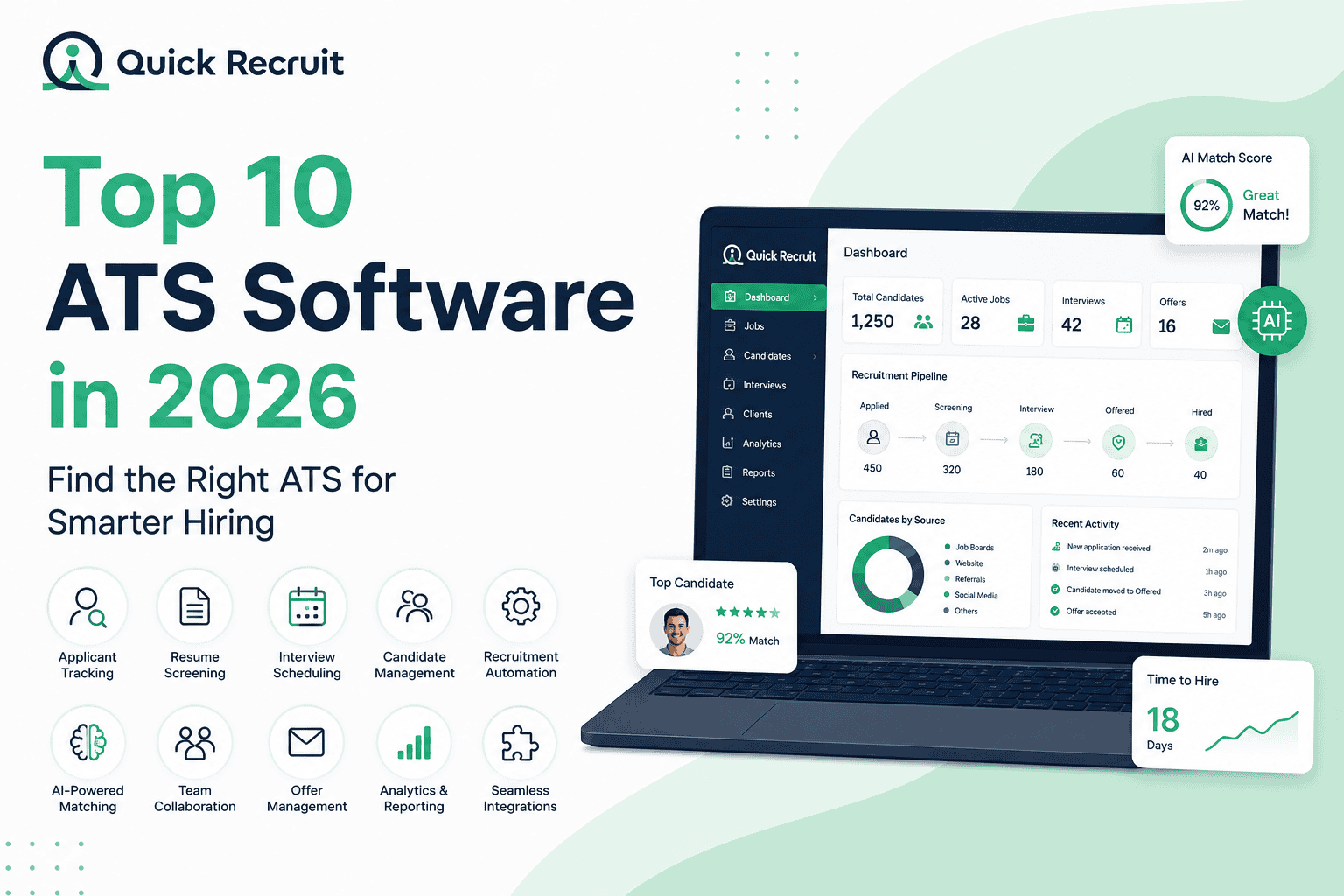
This guide covers the Top 10 ATS software in 2026 — the applicant tracking systems worth considering if your hiring process is buried in spreadsheets, scattered resumes, and manual follow-ups.
A recruiter may have dozens of open positions, hundreds of resumes, interview schedules, hiring-manager feedback, emails, and candidate updates to manage at the same time. When all of this is handled through spreadsheets and separate tools, it becomes harder to keep track of what is happening at every stage.
This is where ATS software can make a difference.
An Applicant Tracking System (ATS) helps recruiters organize candidates, manage job applications, track hiring stages, collaborate with hiring teams, and automate parts of the recruitment process.
But with so many recruitment platforms available today, choosing the right one can take time.
To make that process easier, here is a look at 10 ATS software platforms to consider in 2026, including their core recruitment capabilities and the types of hiring teams they can support.
Note: This is a curated list, not a universal ranking. Every organization has different hiring requirements, so the right ATS depends on factors such as hiring volume, recruitment workflows, team size, integrations, and business needs.
Table of Contents
What Is an ATS?
An Applicant Tracking System (ATS) is software that helps organizations manage their recruitment process in one place.
Instead of keeping candidate information across spreadsheets, email inboxes, folders, and multiple applications, recruiters can use an ATS to organize the hiring workflow digitally.
Depending on the platform, an ATS can help with:
- Creating and publishing job openings
- Collecting applications
- Parsing resumes
- Searching candidate databases
- Screening candidates
- Managing recruitment pipelines
- Scheduling interviews
- Communicating with candidates
- Collaborating with hiring managers
- Managing offers
- Tracking recruitment metrics
Modern ATS platforms are also moving beyond basic candidate tracking. Many now include AI-powered sourcing, candidate matching, resume screening, automation, analytics, and candidate engagement tools.
Why Are ATS Platforms Important for Recruiters?
Recruitment involves many small tasks that can take up a significant amount of a recruiter’s day.
An ATS brings these activities into a structured workflow.
For example, instead of manually checking which candidates have completed an interview, a recruiter can view the candidate pipeline and see where each applicant currently stands.
Similarly, instead of searching through hundreds of resumes manually, recruiters can use search, filters, parsing, matching, and screening features available within their recruitment platform.
The goal is simple:
Spend less time managing recruitment administration and more time making meaningful hiring decisions.
Top 10 ATS Software in 2026
1. QuickRecruit
Quick Recruit is an AI-powered, End-to-end recruitment platform that brings ATS and CRM capabilities together, helping recruitment teams and staffing agencies manage the entire hiring process in one place.
This platform manages the entire hiring journey in one place—from job posting to AI-powered sourcing, screening, shortlisting, and interview scheduling.
For recruiters, this helps them review candidates, manage jobs pipelines, and keep all recruitment information in one place.
Key capabilities include:
- AI-Powered Candidate Sourcing
- AI Resume Parsing
- AI-Assisted Resume Screening
- AI-Powered Candidate Matching
- Applicant Tracking System (ATS)
- AI-Powered Calling
- Q-Call
- Recruitment CRM
- Candidate & Client Management
- Job Management
- Interview Scheduling
- Candidate Evaluation
- Omnichannel Integration
- Recruitment Reports & Analytics
- Team Collaboration
- Advanced Search & Filtering
QuickRecruit is particularly relevant for teams looking for an AI-powered recruitment platform that combines ATS and CRM functionality.
2. Zoho Recruit
Zoho Recruit is an Applicant Tracking System and recruitment platform designed for both staffing agencies and corporate hiring teams.
The platform covers several stages of recruitment, including candidate sourcing, resume management, applicant tracking, interview scheduling, communication, and hiring. Zoho also provides recruitment automation and integrations with other tools.
Recruiters can use the platform to organize candidate information, manage hiring workflows, and keep recruitment activities within one system.
Key capabilities include:
- Applicant tracking
- Candidate sourcing
- Resume management
- Interview scheduling
- Recruitment automation
- Candidate communication
- Recruitment CRM
- Search and filtering
- Job board integrations
- Recruitment workflows
Zoho Recruit can be considered by organizations that want an ATS with recruitment management and CRM capabilities.
3. TalentRecruit
TalentRecruit is an AI-powered recruitment and Applicant Tracking System focused on helping organizations manage their hiring lifecycle.
The platform supports recruitment automation, candidate evaluation, screening, recruitment workflows, analytics, and onboarding. Its ATS also provides configurable recruitment workflows, allowing organizations to adapt processes to their hiring requirements.
TalentRecruit also highlights AI-powered screening and skill intelligence to help recruiters evaluate candidates against job requirements.
Key capabilities include:
- Applicant tracking
- AI-powered candidate screening
- Resume parsing
- Candidate evaluation
- Recruitment automation
- Configurable workflows
- Recruitment analytics
- Candidate engagement
- Onboarding workflows
- Skill-based matching
TalentRecruit can be a relevant option for organizations managing structured or high-volume recruitment processes.
4. CEIPAL ATS
CEIPAL provides an Applicant Tracking System as part of a broader talent acquisition platform.
Its recruitment technology supports candidate sourcing, resume management, candidate matching, ranking, engagement, job management, and recruitment workflows. CEIPAL also combines ATS capabilities with other staffing and workforce-management tools.
The platform uses AI for areas such as candidate sourcing, matching, ranking, and engagement.
Key capabilities include:
- Applicant tracking
- AI-powered candidate matching
- Candidate ranking
- Resume parsing
- Resume harvesting
- Candidate sourcing
- Job posting
- Candidate engagement
- Recruitment analytics
- VMS integration
CEIPAL can be particularly relevant for staffing organizations and recruiting teams managing large candidate pools and multiple recruitment workflows.
5. Keka
Keka is an HR and workforce platform that includes recruitment and Applicant Tracking System capabilities.
Its recruitment platform covers activities from job creation and distribution to candidate tracking, screening, interviews, offers, and onboarding handoff. Keka also provides AI-powered job description and screening capabilities.
The platform connects recruitment with broader HR processes, allowing organizations to manage hiring and employee information within the same ecosystem.
Key capabilities include:
- Job creation and distribution
- Applicant tracking
- Candidate pipeline management
- AI-powered resume parsing
- Candidate screening
- Skill assessments
- Interview scheduling
- Offer management
- Onboarding handoff
- HR integration
Keka can be considered by organizations that want recruitment capabilities connected with a wider HR management platform.
6. Darwinbox
Darwinbox is an enterprise HR technology platform that includes talent acquisition and recruitment capabilities.
Its recruitment platform is designed to support the broader talent acquisition lifecycle, from workforce planning and hiring through post-hire processes and analytics. Darwinbox describes its recruitment offering as an AI-enabled ecosystem for talent acquisition.
The platform forms part of Darwinbox’s wider HCM ecosystem, connecting recruitment with other areas of employee management.
Key areas include:
- Talent acquisition
- Recruitment workflows
- Candidate management
- Interview management
- Offer management
- AI-enabled recruitment
- Talent analytics
- HR integration
- Employee lifecycle management
Darwinbox can be a relevant choice for enterprises looking to connect recruitment with their wider HR technology environment.
7. Workable
Workable is a recruitment and hiring platform that provides Applicant Tracking System capabilities for businesses.
Its ATS supports candidate management, job applications, interview scheduling, hiring workflows, candidate evaluation, reporting, and recruitment automation. The platform also includes features such as resume parsing, candidate sourcing, interview kits, scorecards, and automated actions.
Workable also incorporates AI-powered recruitment capabilities into its platform, helping teams source, review, and engage candidates.
Key capabilities include:
- Applicant tracking
- Candidate sourcing
- Resume parsing
- Interview scheduling
- Interview scorecards
- Candidate evaluation
- Custom hiring pipelines
- Recruitment reporting
- Automated recruitment actions
- Candidate relationship management
Workable is an option for organizations looking for a recruitment platform that combines applicant tracking with sourcing and hiring workflow tools.
8. PeopleStrong
PeopleStrong is an HR technology platform that includes Talent Acquisition and Recruitment as part of its broader HR ecosystem.
Its recruitment technology focuses on helping organizations source, identify, assess, and manage candidates through different stages of hiring.
PeopleStrong highlights AI-powered recruitment, resume parsing, candidate-job matching, job distribution, automated workflows, interview management, candidate communication, and recruitment analytics.
Key capabilities include:
- Candidate sourcing
- Applicant tracking
- Resume parsing
- AI-powered candidate-job matching
- Job distribution
- Recruitment automation
- Interview management
- Candidate communication
- Recruitment analytics
- Onboarding integration
PeopleStrong can be considered by organizations looking for recruitment technology that connects with broader HR and employee lifecycle processes.
9. BambooHR
BambooHR is an HR platform that includes an integrated Applicant Tracking System for recruitment teams and hiring managers.
Its ATS helps organizations organize applicant information throughout the hiring process. It also supports job posting, candidate review, hiring team collaboration, offer management, and candidate communication.
Because the ATS is integrated with the wider BambooHR platform, recruitment can connect with other HR processes.
Key capabilities include:
- Applicant tracking
- Job posting
- Candidate management
- Hiring team collaboration
- Candidate communication
- Interview and evaluation workflows
- Offer management
- Mobile hiring capabilities
- HR platform integration
BambooHR can be considered by organizations that want recruitment functionality as part of a broader HR platform.
10. SmartRecruiters
SmartRecruiters provides an enterprise-focused Applicant Tracking System and talent acquisition platform.
Its ATS is designed to help recruitment teams manage candidate progress, hiring workflows, communication, collaboration, talent pools, and recruitment processes from one platform.
The platform also includes AI capabilities and a broader ecosystem of recruitment integrations.
Key capabilities include:
- Applicant tracking
- Candidate sourcing
- Talent pools
- Advanced search and filtering
- Candidate communication
- Hiring team collaboration
- Recruitment automation
- Recruitment analytics
- AI-powered recruitment tools
- HR and recruiting integrations
SmartRecruiters can be considered by organizations looking for a talent acquisition platform designed around structured and scalable recruitment processes.
How to Choose the Right ATS Software
There is no single ATS that works perfectly for every company.
A startup hiring a few people each month may have very different requirements from a staffing agency processing hundreds of candidates every week.
Before selecting an ATS, think about your actual recruitment process.
1. Understand Your Hiring Volume
Start by looking at how many positions you normally hire for and how many applications each position receives.
A high-volume recruitment team may need stronger automation, search, screening, and candidate-management capabilities.
2. Look at Automation
Ask which repetitive tasks the ATS can automate.
For example:
- Resume parsing
- Candidate screening
- Interview scheduling
- Candidate notifications
- Job posting
- Approval workflows
- Recruitment reports
The more repetitive work you can automate, the more time recruiters can spend on candidates and hiring decisions.
3. Check Candidate Management
Your ATS should make it easy to understand where every candidate is in the recruitment process.
A clear pipeline can help recruiters see candidates who are:
Applied → Screening → Interview → Evaluation → Offer → Hired
The exact stages can be customized depending on the organization’s hiring process.
4. Consider AI Features Carefully
AI is becoming an important part of recruitment technology.
Modern ATS platforms may use AI for sourcing, resume parsing, candidate matching, screening, job descriptions, communication, scheduling, and analytics.
However, AI should support recruiters rather than completely replace human judgment.
Recruiters still need to evaluate experience, skills, communication, culture contribution, and other factors that technology may not fully understand.
5. Check Integrations
Recruitment rarely happens inside one tool.
Before choosing an ATS, check whether it integrates with the tools your team already uses, such as:
- Calendars
- Video interview platforms
- Assessments
- Communication platforms
- Call Integrations
6. Look at Reporting
Good recruitment decisions need good data.
Your ATS should help your team understand recruitment metrics such as:
- Time to hire
- Time to fill
- Source of candidates
- Candidate conversion rates
- Interview-to-hire ratio
- Offer acceptance
- Recruiter activity
- Hiring pipeline
These insights can help identify where your recruitment process is working and where it needs attention.
Without an ATS
A recruiter might:
- Post a job manually.
- Receive resumes through different channels.
- Store candidate information in spreadsheets.
- Search through resumes manually.
- Send individual emails.
- Track interviews separately.
- Collect feedback through email or messages.
- Update the hiring status manually.
With an ATS
The recruitment process can become more structured:
- Create the job.
- Publish it through connected channels.
- Collect applications in one place.
- Screen and search candidates.
- Move candidates through defined stages.
- Schedule interviews.
- Collect feedback.
- Track offers and hiring progress.
- Review recruitment reports.
The exact workflow depends on the ATS and the organization’s recruitment process, but the underlying goal remains the same: make hiring easier to manage and easier to measure.
Final Thoughts
Choosing the best ATS software is less about finding the platform with the most features and more about finding one that fits the way your team hires.
The 10 platforms covered in this article—QuickRecruit, Zoho Recruit, TalentRecruit, CEIPAL ATS, Keka, Darwinbox, Workable, PeopleStrong, BambooHR, and SmartRecruiters—take different approaches to applicant tracking, recruitment automation, talent acquisition, and HR management.
Some combine ATS functionality with CRM capabilities. Others connect recruitment closely with broader HR platforms. Several also use AI to support sourcing, screening, matching, automation, and decision-making.
Before making a decision, involve the people who will actually use the system.
Ask your recruiters:
“What takes the most time in our hiring process today?”
Then look for an ATS that can solve those specific problems.
The right Applicant Tracking System should not simply hold resumes.
It should help your recruitment team organize candidates, reduce repetitive work, collaborate better, and spend more time on what matters most—hiring the right people.
What is the best ATS software in 2026?
There is no single best ATS for every organization. The right platform depends on hiring volume, company size, recruitment workflows, integrations, budget, and the features your recruitment team needs.
What does ATS stand for?
ATS stands for Applicant Tracking System. It is software used to organize and manage candidates and different stages of the recruitment process.
What does ATS software do?
ATS software can help recruiters manage job openings, collect applications, organize candidate information, screen applicants, schedule interviews, communicate with candidates, collaborate with hiring teams, and track recruitment data.
Is ATS software useful for small businesses?
Yes. An ATS can help small businesses organize candidate information and reduce manual recruitment work. The right platform depends on the company’s hiring volume and requirements.
Do ATS platforms use AI?
Many modern ATS platforms include AI-powered capabilities. Depending on the product, these can include candidate sourcing, resume parsing, candidate matching, screening, job description creation, communication, scheduling, and analytics.
Can an ATS replace recruiters?
No. An ATS is primarily a technology tool that helps recruiters manage and automate parts of the hiring process. Human recruiters still play an important role in evaluating candidates, conducting interviews, building relationships, and making hiring decisions.