
Hiring has become more complex than ever. Recruiters today manage hundreds of resumes, multiple job openings, candidate communication, interviews, and hiring decisions at the same time.
As hiring demands increase, many recruitment teams are adopting recruitment automation to improve efficiency and reduce repetitive manual work. However, automation does not mean replacing recruiters. The best hiring processes combine AI-powered recruitment software with human expertise.
The key question is not whether recruiters should automate hiring tasks, but rather:
Which recruitment activities should be automated, and which ones still require human judgment?
Understanding this balance helps recruiters build faster, smarter, and more candidate-friendly hiring processes.
What is Recruitment Automation?
Recruitment automation refers to using technology, artificial intelligence, and recruitment software to automate repetitive tasks throughout the hiring process.
It helps recruiters manage activities such as:
- Job posting
- Resume screening
- Candidate sourcing
- Interview scheduling
- Recruitment workflow management
- Reporting and analytics
Modern AI recruitment automation tools can analyze candidate information, identify relevant skills, and help recruiters make faster hiring decisions.
However, automation works best when it supports recruiters rather than completely replacing human involvement.
Why is Recruitment Automation Important?
Traditional recruitment processes often involve several time-consuming activities. Recruiters spend hours reviewing resumes, updating spreadsheets, following up with candidates, and coordinating interviews.
According to industry research, recruiters spend a significant amount of time on administrative tasks instead of focusing on strategic hiring activities.
Recruitment automation helps organizations:
1. Reduce Manual Work
Automation handles repetitive tasks like resume sorting, email responses, and interview scheduling, allowing recruiters to focus on candidate relationships.
2. Improve Hiring Speed
Automated workflows help reduce delays between job posting, candidate screening, and interview coordination.
3. Improve Candidate Experience
Fast communication and smooth hiring processes create a better experience for candidates.
4. Make Data-Driven Hiring Decisions
Recruitment analytics provide insights into hiring performance, sourcing channels, and candidate pipelines.
Recruitment Tasks That Should Be Automated
1. Resume Screening and Candidate Shortlisting
Resume screening is one of the most repetitive tasks for recruiters.
An AI-powered recruitment software can analyze resumes, identify relevant skills, experience, and qualifications, and help recruiters shortlist suitable candidates faster.
Instead of manually checking hundreds of resumes, recruiters can use automation to identify potential matches while still making the final hiring decision.
Benefits of automated resume screening:
- Saves recruiter time
- Reduces manual errors
- Improves candidate matching
- Creates a consistent screening process
2. Job Posting and Distribution
Recruiters often publish the same job opening across multiple platforms.
Recruitment automation can simplify this process by allowing recruiters to create job posts and distribute them across different channels efficiently.
Automation helps maintain consistency in:
- Job descriptions
- Candidate requirements
- Employer branding messages
3. Interview Scheduling
Scheduling interviews between recruiters, hiring managers, and candidates can become complicated.
Automated interview scheduling tools reduce unnecessary communication by allowing candidates and interviewers to find suitable time slots.
This helps:
- Reduce scheduling delays
- Avoid back-and-forth emails
- Improve candidate experience
4. Candidate Communication
Candidate engagement plays an important role in successful hiring.
Automation can support recruiters by sending:
- Application confirmations
- Interview reminders
- Status updates
- Follow-up messages
However, communication should still include human interaction during important stages of the hiring journey.
5. Recruitment Reporting and Analytics
Recruitment teams need data to understand what is working and what needs improvement.
Recruitment automation tools can track important hiring metrics such as:
- Time-to-hire
- Cost-per-hire
- Source of candidates
- Interview conversion rates
- Hiring pipeline performance
These insights help recruiters improve their overall recruitment strategy.
Recruitment Tasks That Should Stay Human
While automation improves efficiency, some parts of recruitment require emotional intelligence, understanding, and human judgment.
1. Building Candidate Relationships
Recruitment is not only about finding candidates; it is about building trust.
Candidates want to communicate with recruiters who understand their career goals and expectations.
Human recruiters are better at:
- Understanding candidate motivations
- Creating personal connections
- Providing career guidance
A chatbot or automated message cannot replace genuine human interaction.
2. Final Candidate Evaluation
AI tools can identify patterns and recommend suitable candidates, but final decisions require human judgment.
Recruiters need to evaluate:
- Cultural fit
- Communication skills
- Career goals
- Long-term potential
Hiring decisions should always include human review to avoid biased or incomplete evaluations.
3. Candidate Interviews
Interviews are more than collecting answers.
Experienced recruiters understand:
- Candidate confidence
- Problem-solving approach
- Communication style
- Professional attitude
Human conversations provide insights that automation alone cannot capture.
4. Employer Branding and Candidate Experience
Recruiters play a major role in representing company culture.
Creating a positive candidate experience requires:
- Personalized communication
- Understanding candidate concerns
- Building employer trust
Automation can support these activities, but recruiters create the relationship.
Finding the Right Balance Between Automation and Human Recruiting
Successful recruitment teams do not choose between technology and people. They combine both.
A balanced recruitment process looks like this:
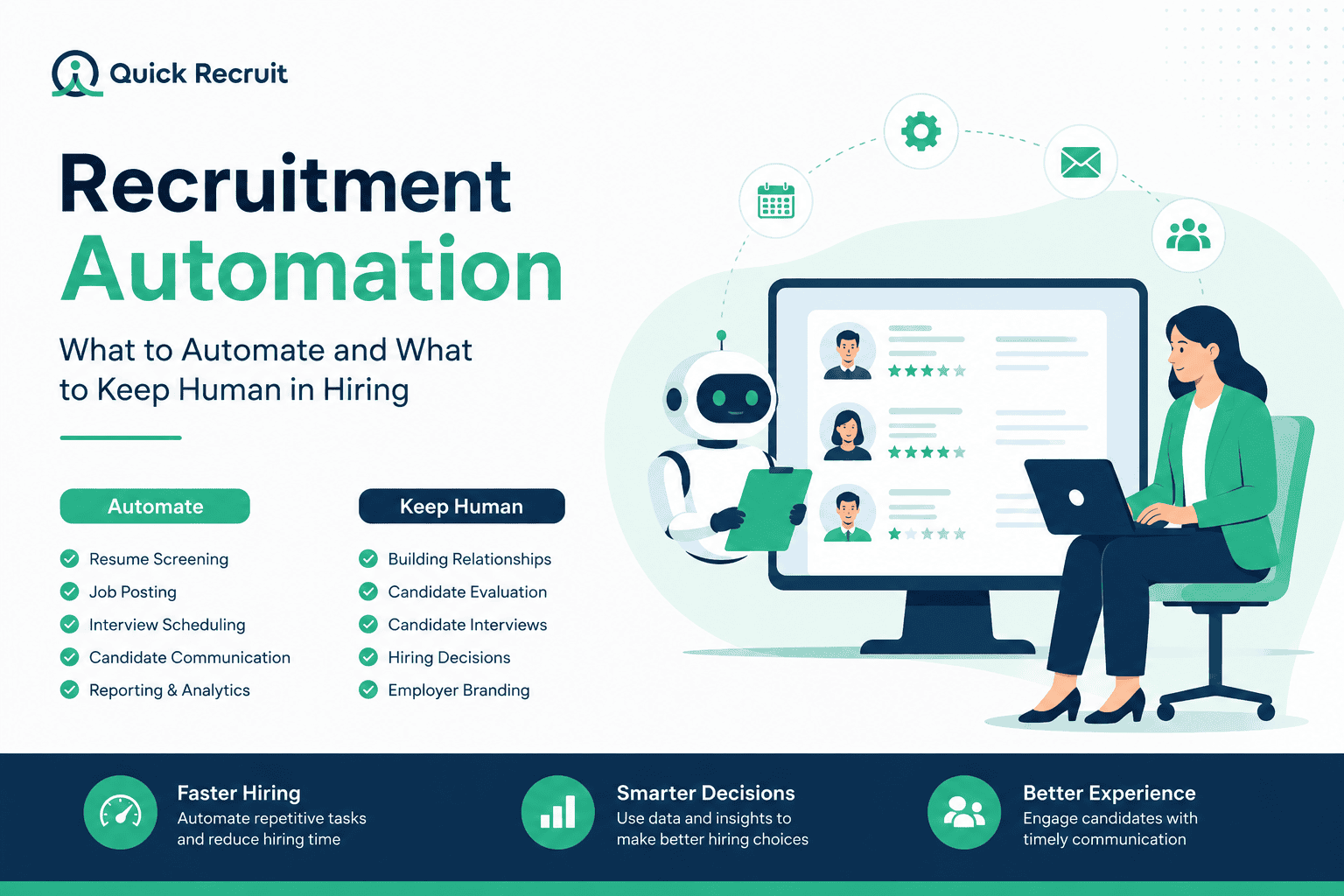
Automation handles:
- Resume filtering
- Candidate database management
- Interview scheduling
- Recruitment workflows
- Reporting
Humans handle:
- Candidate relationships
- Final interviews
- Hiring decisions
- Employer branding
- Strategic planning
The future of recruitment is not about replacing recruiters with AI. It is about helping recruiters spend more time on meaningful hiring activities.
How Recruitment Automation Will Shape the Future of Hiring
The future of talent acquisition will focus on collaboration between recruiters and technology.
With advancements in AI recruiting tools, recruiters will be able to:
- Find qualified candidates faster
- Improve hiring accuracy
- Reduce administrative workload
- Create better candidate experiences
Organizations that adopt recruitment automation strategically will have a competitive advantage in attracting top talent.
Conclusion
Recruitment automation is transforming the way companies hire. By automating repetitive tasks and keeping human involvement where it matters most, recruiters can create faster and more effective hiring processes.
The goal of automation is not to remove the human element from recruitment. Instead, it helps recruiters focus on what they do best — connecting with people, understanding talent, and making better hiring decisions.
The future of recruitment belongs to teams that combine AI-powered technology with human expertise.
What is recruitment automation?
Recruitment automation uses AI and software to automate repetitive hiring tasks like resume screening, scheduling, and candidate communication.
What tasks can be automated in recruitment?
Tasks like job posting, resume screening, interview scheduling and reporting can be automated.
What should remain human in recruitment?
Interviews, relationship building, cultural fit assessment, and final hiring decisions should always involve human recruiters.
Does recruitment automation replace recruiters?
No. It supports recruiters by reducing manual work, allowing them to focus on strategic hiring and candidate engagement.
What are the benefits of recruitment automation?
It saves time, improves hiring efficiency, enhances candidate experience, and streamlines recruitment workflows.